

Automotive Dealers: The ABC of Web Advertising

In 2013, DesRosiers Consultants and its team conducted a survey of 263 Canadian automotive dealerships titled Dealers in a Digital World. At that time, dealerships claimed to invest 30% of their advertising budget on the Web and only 7% on social media. However, respondents estimated that the percentage would increase to 43% and 18% respectively within five years (61% total).
Here we are in 2018. Although we don't have exact figures, Andrew Assad, Strategy and Insight Manager at Google, mentioned last year at Google Think Auto that only 9% of Canadian dealerships' budget was spent online, with the rest allocated to traditional media. Too pessimistic? Perhaps. The fact remains we're far from 60%.

Andrew Assad, Strategy and Insight Manager at Google
According to Google, 45% to 75% of advertising and marketing budget should be invested on the Web. Well, it's true, the Internet giant is undoubtedly showing bias…
But one thing is clear: your customers are on the Web. It's not complicated: according to Google, 95% of vehicle buyers use digital as a source of information. The majority start their search online rather than at a dealership.
At CSMO-Auto, they say 66% of people used Google for information about sales, maintenance, or automotive repair. See here.
Hence THE question this dossier will attempt to answer: how can we transfer these potential sales from the Web to your business?
THE DIFFERENT ONLINE STRATEGIES
Keywords
Keyword purchases are made on search engines, with Google holding a large share of the market. These are, for example, the various sponsored links that appear at the top of the page when you search the Internet. They are often identified by the word "Ad".
On Google, advertisers use the AdWords platform to bid on keywords that interest them. For each search a user makes, Google auctions the available space. Normally, the important factors that influence the auction result are the client's maximum bid for a click multiplied by the relevance of the link relative to what the user is searching for. The advertiser only pays when a user clicks on the link they sponsored.
Update: For some months now, the AdWords service is part of the Google Ads suite, which includes: Google Ads, Google Marketing Platform, and Google Ad Manager.

Google AdWords Example (note the presence of the small green square with the Ad mention, which confirms this is indeed a paid placement)
Display
We all know display ads, which exist in various formats (banner, skyscraper, etc.). They're found on virtually all websites. Here too, Google dominates the game. Display advertising purchases on Google are made via the Google AdSense program. As with keyword purchases, available spaces on Google partner sites are offered at auction.
Generally, clients opt for a pay-per-click system (CPC/PPC), but sometimes clients pay per thousand impressions (CPM) or even per action (CPA).
Although a large portion of display advertising inventory on the Web comes from Google AdSense, some media outlets still handle selling their own advertising space or will call on a specialized agency to manage the supply. This is the case, for example, with Guide de l'auto, which works with M32 agency, the same one that places inventory with TC Media, Télé-Québec, Cogeco Media, etc.
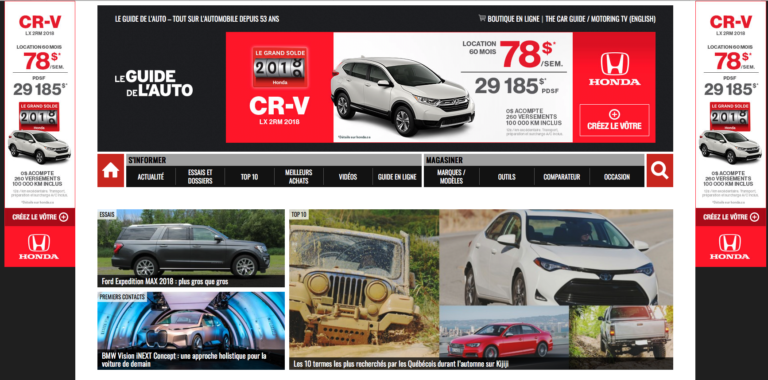
Display example on the Guide de l'Auto website.
Video
My children will never know antenna television or even cable. Their daily dose of videos is delivered via YouTube and Netflix. Since the latter doesn't offer advertising, it's YouTube (Google again) that captures a large portion of video advertising inventory on the Web (excluding social media). Not convinced? According to YouTube, the video platform reaches 1.5 billion users each month and one billion hours of videos are consumed on YouTube every day. Moreover, according to Cisco, by 2021, 80% of Internet traffic will be video-related.
the video platform reaches 1.5 billion users each month and one billion hours of videos are consumed on YouTube every day.
These figures can't help but touch the automotive industry. According to a study conducted by Google on automotive consumer habits, more than 40% of buyers who watched a video about cars or trucks subsequently visited a dealership.
Reached by phone, Deepak Anand, Head of Auto and Consumer Goods at Google, explains that there are two basic ways for dealers to use YouTube.
First, YouTube is a warehouse for hosting videos. Today, when you have a vehicle to sell, especially used, you must provide a large number of photos and, ideally, one or two videos. YouTube allows dealers to host said videos. It's easy, free, and you can integrate virtual reality, 360 videos, etc.
Furthermore, YouTube is an advertising platform capable of targeting the right people by identifying audiences to show the video to. Google/YouTube has the ability to identify people who are in-market (completely anonymously). The goal is always to deliver the right content to the right person.
Let's take the example of a user searching for a pickup truck. YouTube can identify them as a potential buyer. By showing them an ad promoting a pickup promotion at a local dealership, the ad becomes useful content. And remember that if the client doesn't watch the ad, no fee is charged to the dealership.

Deepak Anand, Head of Auto & Consumer Goods at Google
We need to stop assuming we know all our buyers, he says. If I'm selling trucks, it's not necessarily a construction worker in their forties who will be shopping.
Deepak wants to remind us that we don't always know our potential clients. « We need to stop assuming we know all our buyers, he says. If I'm selling trucks, it's not necessarily a construction worker in their forties who will be shopping. It could be a newly retired woman who has always wanted to own a truck and is now ready to take action. The idea is always to reach the right client at the right time, and YouTube has all the tools to do that. »
We asked Deepak if he knew what percentage of dealerships used YouTube to their advantage. « I don't have exact figures, he answered. But we know it's a minority. I'd say half of them use Google Search and less than 20% of dealerships use YouTube, and it's mainly groups or larger dealerships. »
Social Media
Social media offers a range of options for disseminating advertising within their platform. Thanks to the ability to target their audiences very precisely, social media advertisers reap good success. For now, Facebook remains the king of social media, helped by Instagram, which FB acquired in 2014 for one billion US dollars.
GOOGLE: THE UNAVOIDABLE
The importance of Google for automotive dealerships is obvious. Before even thinking about spending money on Google advertising, you need to ensure you have a solid foundation. Here's how to ensure it:
Is my website adequate?
Once you've hooked a potential client through web advertising, and they're now on your site, the site must immediately respond to their needs.

Daniel Ferland, National Development Director at DealerCity
Daniel Ferland, National Development Director at DealerCity, explains: « There are dealerships that are always present on the Web. But when you click on the link, you land on a poor site that doesn't convert, that doesn't work well on mobile, etc. At that point, we know they've skipped steps. »
Do I have the necessary resources to manage traffic from the Web?
Still according to Daniel Ferland, « with the Web, it's possible to grow, and quickly. However, if the dealership doesn't have the resources to handle requests or even enough vehicles to meet demand, it's better to step back and correct these gaps. Internet users are demanding and impatient. They won't wait for you to respond. »
Am I maximizing Google Business?
Not everything on Google is paid. For example, Google My Business is a free tool that allows businesses to manage their online presence on Google, including on Google Maps. The more information you provide to Google My Business, the better your business will be indexed on Google.
The AdWords War
There's a lot of competition for your business name to appear first in organic search engine results. Even within AdWords, which auctions sponsored links, competition is fierce. Some groups spend millions of dollars on AdWords each year. Is there still room for smaller players?
Some groups spend millions of dollars on AdWords each year. Is there still room for smaller players?
Deepak Anand says yes. Google always aims to help the client first. So, if a consumer searches for a Honda dealership in Laval, Google will first show them dealership options in Laval before showing them the sponsored link of a Honda dealership located in Montreal, for example.
According to Emiliano Ubaldi, SEM (Search Engine Marketing) Director at DealerCity, a dealership can expect to spend an average of $3,000 per month (plus management fees) for a new car brand. For used, it's more like $2,000, and for credit sites, around $1,500. These are very generic averages, and especially will vary according to four important factors: location (geographic target), brand, objective, and expectations.
a dealership can expect to spend an average of $3,000 per month (plus management fees) for a new car brand. For used, it's more like $2,000, and for credit sites, around $1,500.

Emiliano Ubaldi, SEM (Search Engine Marketing) Director at DealerCity
The most important thing is to properly calculate expectations. For example, how many potential clients would the dealership like to receive monthly? Let's say they want to get 50 conversions per month and have a budget of $2,500 per month. In this case, the CPC (cost per conversion) will be $50, that is 50 conversions × $50 = their $2,500 budget
Daniel Ferland adds: « What's great about AdWords is that the information request comes from the user. If the user doesn't click, it costs nothing. But if the user clicks, the dealership finds themselves with a potential buyer on their site. The sales funnel is already 75% engaged. Now, it's up to the dealership to ensure their AdWords campaign is well set up (hence the importance of a specialized agency), that the user lands on the right page, which will ideally display a promotion they can't refuse. Don't forget: you must respond to the client immediately, as soon as they contact us. »
Borders Are Expanding
Even though Google recommends options close to the client, it's a fact that with the arrival of the Web, geographic borders are increasingly elastic. According to Deepak, people are willing to travel 60 and even 70 kilometers to save hundreds of dollars on a car worth several thousand dollars. However, clients won't drive an hour to save 50% on an oil change.
people are willing to travel 60 and even 70 kilometers to save hundreds of dollars on a car worth several thousand dollars
Online Sales: Yes or No?
With all this frenzy we see on the Web, we can afford to ask the question no one wants to hear: is the automotive industry approaching a complete online shopping experience? After all, according to Google, consumers visit an average of no more than two dealerships when they're ready to take action (down from three in 2016).
Deepak Anand is convinced yes.
« It's really the big missing piece in Canada. We have more than 3,500 dealerships in Canada and only one or two that can take an online deposit and, ultimately, sell or deliver the vehicle to the client. Yet, people are ready to buy cars online.
« Even worse, less than 5% of dealerships are open on Sunday. I find it strange that the industry doesn't favor the same modus operandi as all other retail businesses. In Ontario, this trend is quietly changing because they understand that people are simply too busy. They don't have time to shop for a car during the week. We need to offer clients a good shopping experience at a time that suits them.
« We've also noticed that since digital became part of the equation, used car sales are increasing. One of our hypotheses at Google is that you can buy a used car when new car dealerships are closed. The biggest day for used car searches on Google is Sunday.
« We also did an analysis for one of our major clients. It showed that practically none of their dealerships are open on Sunday. Yet, 5% of their calls from Google Search and Google Maps are made on Sunday. By the time the dealership returns the call on Monday, the chances are very slim that the client is still there. »
FACEBOOK: THE KING OF SOCIAL MEDIA
Every month, there are 2.2 billion people on Facebook and 800 million on Instagram (which belongs to Facebook). More than three-quarters (78%) of Canada's Internet population is on Facebook (23 million users in the country). As for Instagram, 8.5 million Canadians use the platform each month.
All these users are also your clients. According to a study done by Facebook, nearly half (47%) use Facebook to get information about vehicles and 29% use Instagram. It's also interesting to note that 42% of them would prefer to do the entire vehicle purchase process online and that 55% only go to the dealership to complete their transaction.

The Facebook Advantage
Targeting: One of Facebook's advantages is the ability to target desired potential clients very precisely. « Facebook allows sophisticated targeting that can't be matched by any other media, explains Alex Kucharski, Communications Officer for Facebook. Marketers can personalize ads based on people's tastes and interests, or redirect a consumer to the exact vehicle they searched for. It's personalized marketing on a large scale. »
The Entire Funnel: Car sales are just one of many steps. On Facebook, businesses can maintain a relationship with their clients, from awareness, consideration, and purchase to retention through services, parts, and even the next vehicle purchase.
Messenger: Beyond advertising, Facebook is uniquely positioned in the new era of smart mobility to help automotive marketers meet their clients' expectations. For example, you can interact with the client via Messenger chat.
New but Not So New
Social media is consumed online, but the way to present advertising remains the same as before. For example:
- Facebook video advertising = TV advertising (100 million hours of videos are watched on the platform every day)
- Facebook Canvas format = print advertising
- Custom audiences = direct mail of yesteryear
Format Choices
Facebook allows you to select various advertising formats. For example, the ad can be limited to a very beautiful photo and short text, or can use Carousel (often the preferred method to show inventory), which allows presenting a series of photos. It's also possible to play video ads, slideshows, or use Canvas, a graphic experience that somewhat mimics a magazine.
The format choice will depend, among other things, on the advertiser's objective. A video, for example, proves to be an excellent way to generate awareness and create notoriety for a dealership. « Take HGregoire's videos. The quality is exemplary and the host is good. It's a strategy that allows reaching many people at very low cost, » explains Daniel Ferland.
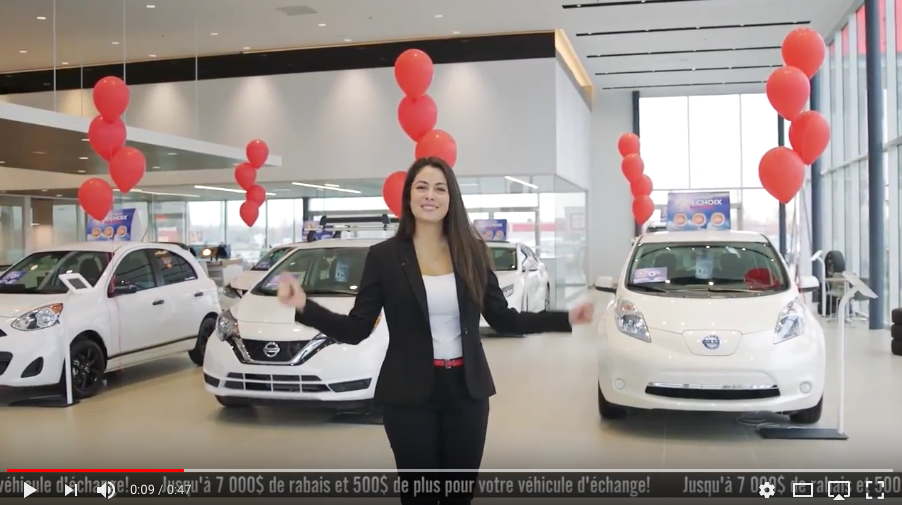
HGregoire Video on YouTube
Lead Ads
Lead Ads are also very popular with automotive dealerships because they redirect clients to a form already pre-filled with information from their own Facebook profile. Note that Lead Ads are also available on Instagram.
Facebook Lead Ads
Lead Ads can be used to sell cars. But you can also vary the strategy. For example, Canadian dealership group Go Auto set up a Lead Ads campaign whose goal was to collect a maximum of contacts and then use the collected information to redirect users to personalized advertising campaigns, such as service promotions for specific car models, or offers to help them reduce their car payments.
New: Marketplace Auto
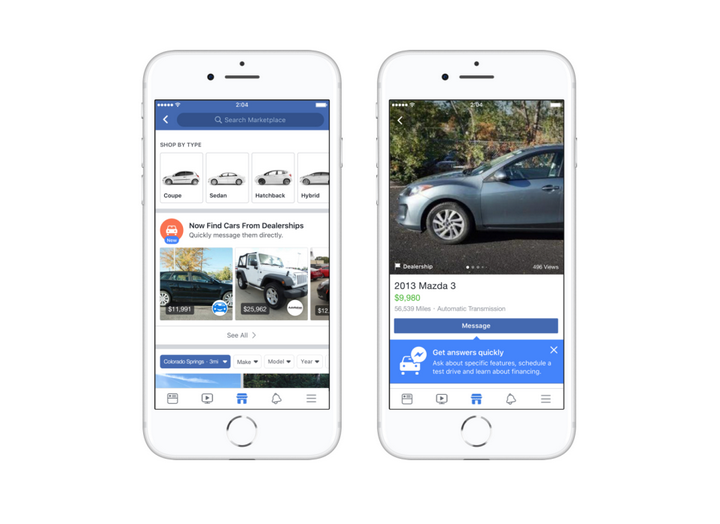
On May 18, Facebook Marketplace announced the expansion of its vehicle category to Canada, thus facilitating online purchase of used cars.
More than 800 million people come to Facebook Marketplace each month to buy and sell things. With this experience, Facebook buyers can:
- Browse used car inventory from automotive dealerships through listing partners like Strathcom Media, CarPages.ca, CarMedia 2.0, Gubagoo, CDK Global
- Streamline their purchase process using filters for year, brand, model, mileage, vehicle type, and transmission
- Communicate directly with dealership representatives via Messenger, powered by chat providers like Gubagoo, ActivEngage!, Contact At Once!
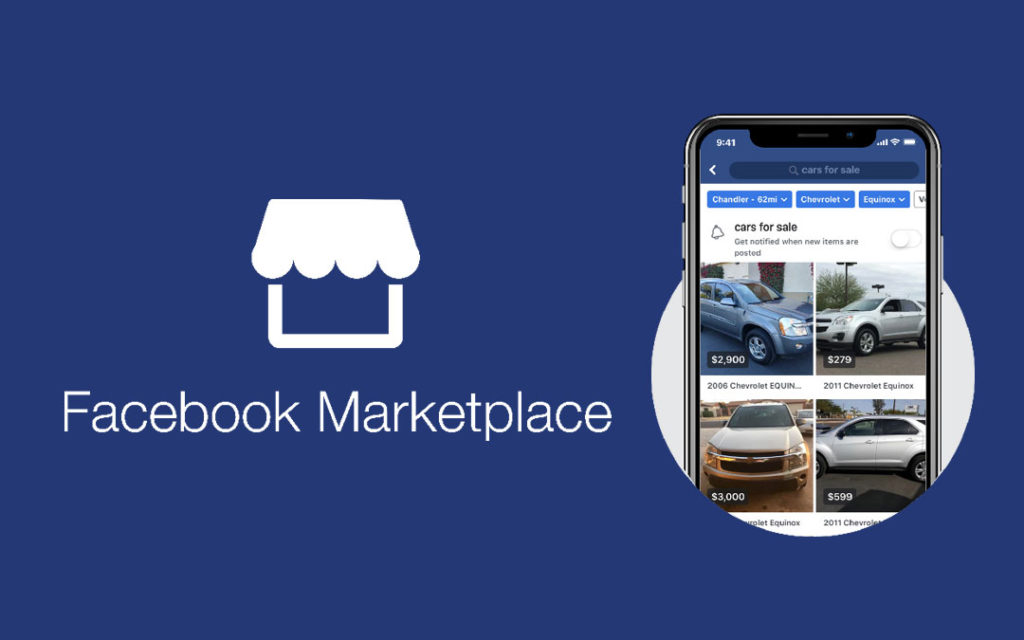
Facebook Marketplace Auto
The photo and video sharing platform is quickly gaining popularity among automotive dealerships. « Instagram is currently a very cost-effective channel on our Dealer.com platform, » mentions Richard Evans, Vice President and General Manager of Dealertrack Canada.
As on Facebook, advertisers can present various ad formats on Instagram: photos, videos, carousels that allow seeing multiple photos, or stories composed of photos or videos.
Instagram ads are created in Ads Manager, the same platform the advertiser uses to distribute ads on Facebook. Marketers can put the same ad on Facebook and Instagram (if ad formats are available on both platforms) at the same time.
NOTE: MOBILITY FIRST

- 63% of Canadians consider their mobile device their primary communication tool.
- 74% of Canadian car buyers conduct most of their research on a mobile device.
- 53% of first-time buyers used mobile.
- 75% use four devices or more.
- 9% of Canadians have 10 devices or more!
- More than 60% of all automotive searches come from a mobile device, and some of the most important mobile searches are related to dealerships. *10
- 18 million Canadians use Facebook on their mobile devices.
Daniel Ferland
Author